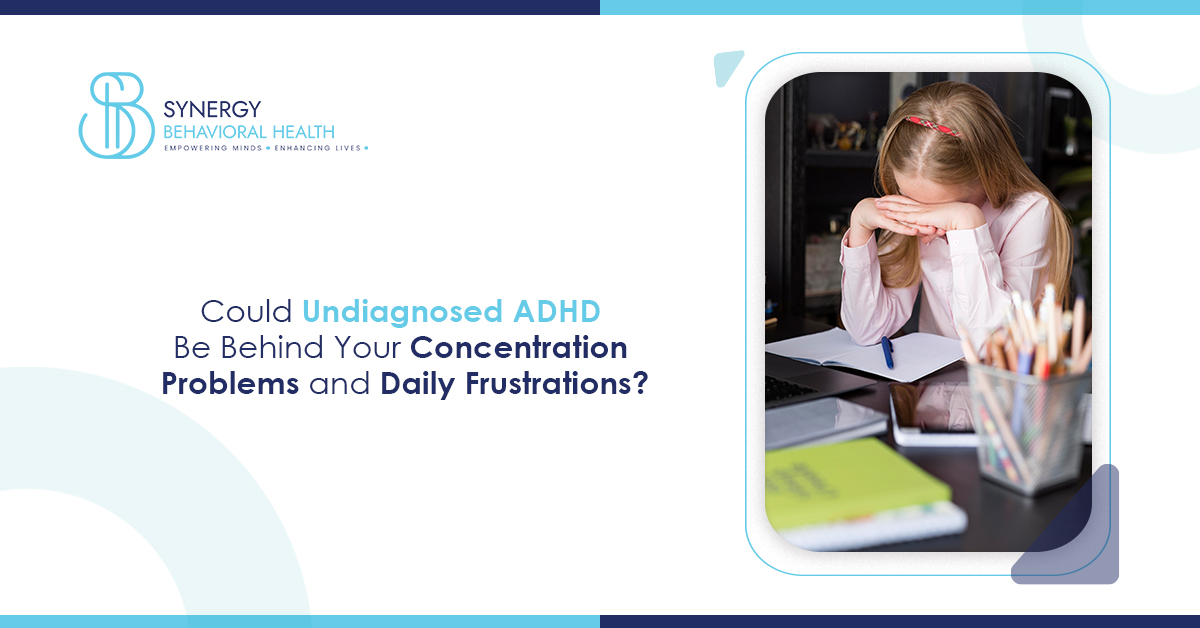
Do you ever sit down to tackle something important and then your brain refuses to work?
Do you ever lose your keys three times in one week?
You may blame it on stress or being ‘scatterbrained’, but what if it is something more?
For many, it is easy to brush this off as personality traits or bad habits, but in fact this may be signs of undiagnosed ADHD that is affecting your everyday life.
What Does Undiagnosed ADHD Actually Look Like?
ADHD can show up in unexpected ways. You may not be hyperactive or bouncing off the walls.
A lot of people with ADHD look completely put together and calm on the outside, but on the inside, their thoughts are racing.
Some things that people with ADHD exhibit that people do not notice:
- Being enthusiastic at the start of a project, but then losing focus halfway through
- Forgetting about appointments, no matter how many reminders are set
- Experiencing some restlessness and boredom, even when it is time to relax
- There is difficulty in listening to conversations, even when one wants to listen to the conversation
These may be even more frustrating and puzzling when you are already giving your best, and things are not working out.
ADHD Underdiagnosis in Adults: Why?
Previously, parents had been told that only boys could get ADHD.
Boys supposedly only had one symptom, which was that they were hyper and couldn’t sit still in school, which meant that if you were doing fine and doing well in school, you were unlikely to get that diagnosis.
Women, in particular, were not seen at all. It was assumed that women had ADHD, though they were never diagnosed.
Their symptoms tend to look like disorganization, emotional sensitivity, or being too talkative rather than the usual hyperactivity.
A lot of women develop really good coping mechanisms that make their struggles really hard to see.
While ADHD is often viewed as a childhood disorder, in reality, it’s not really recognized until adulthood. ADHD never goes away, it just changes.
How Undiagnosed ADHD Affects Your Daily Life
The impact shows up everywhere:
- At work, it’s hard to finish tasks, work feels disorganized, unstructured, like there is a never-ending to-do list, and you are always behind.
- In relations, forgetting important days, being disrespectful, cutting people off when they are speaking, and being disengaged.
- In self-esteem, there’s continuous irritation that results in thinking, “What’s wrong with me?” and “Why can’t I just have everything together?”
- Emotionally, there are mood swings, being overwhelmed, sleeplessness, and being easily offended.
The void in understanding of the situation usually ends in personal blame, conflict, and frustration.
Read more: Always Running Late? How ADHD Affects Time and 10 Ways to Stay on Track
The Relief of Getting Answers
Getting to the final step of receiving the diagnosis can take some time.
For many, the process is entirely new, and for adults getting their first ADHD diagnosis can be life-changing.
ADHD is often looked down upon with negative stereotypes. Just because someone has ADHD does not mean they are lazy, careless or unmotivated.
With some understanding of ADHD and the proper skills to manage tasks, life can be much more productive. Finding the tools to plan and manage your day.
There are many options available. Some consist of therapy, medication, changing some life habits, or simply learning the tools to work with ADHD.
Next Steps
Many adults learn about their ADHD for the first time in their adult lives, receive support they have long needed, and find relief.
Synergy Behavioral Health provides ADHD care and treatment for adults.
There is no reason to spend another day pondering all the ‘what ifs‘. Make the first move to a more effective, more fulfilling, and more focused life.
Book an appointment today.
FAQs
Can you develop ADHD as an adult?
ADHD is a challenge beginning in childhood years, but many people do not have a diagnosis until adult life.
It may feel to the individual that they are developing ADHD, but the truth is that symptoms are now being recognized that have always existed.
What’s the difference between ADHD and just being disorganized?
It is normal and common that a person will lose something like important thing.
Still, ADHD is a disorder that brings alterations in most things in life that are highly influenced, even despite all the efforts that one may have made to fix the disorganization.
Will there be a need for me to take any kind of medication if I happen to get a diagnosis?
Some may prosper with the use of medicine, while others may choose therapy and modifications to their way of life.
Additionally, a lot discover that a mixture is the best option.
You and your provider will be collaborating to find the best solution for your needs.