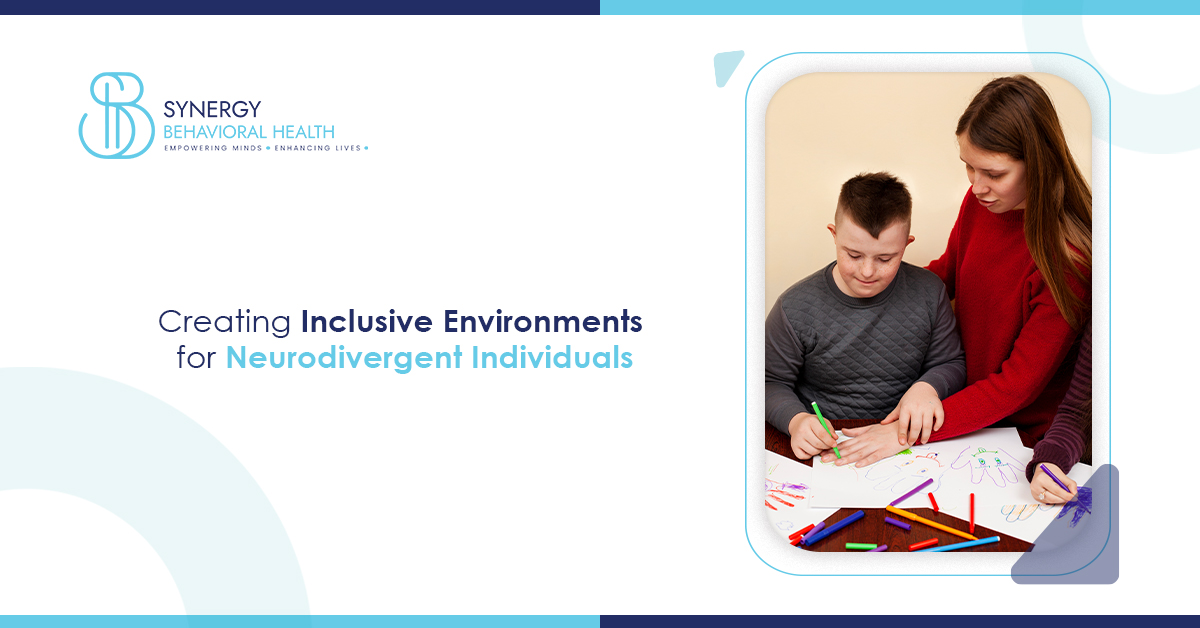
Neurodivergent people include those with:
- Autism
- ADHD
- Dyslexia
- And others
These individuals exhibit the wonderful range of what it means to be human, and like all other types of diversity, neurodivergent individuals call for an examination of our environments, actions, and thought processes.
Neurodivergence Explained
When discussing neurodivergence, consider how the brain is the processor of the world.
Some do so through various filters and at different paces. For example, while one person experiences energy in a crowded room, another one could feel drained.
Someone could work better with background music, while another may work worse with it.
These examples showcase differences in perception and experience in the world. Such differences should become the basis for improving our environment in the world.
Unfortunately, most environments are designed to accommodate one type of brain.
Read more – Can Adults Have Undiagnosed Neurodevelopmental Conditions?
Examples of Simple Changes
The improvement of spaces for neurodivergent individuals does not have to involve big reductions. Some changes can yield great results.
The use of lamps instead of fluorescent lights is one such change. People can be very distracted by fluorescent lights, and lamps can address that.
A space for decompression can be valuable for everyone. On more stressful days, people can go to the less populated safe spots to take a break.
Seating systems can also be different. Some people prefer a firm seat, while others require a softer one. Sitting preferences vary greatly.
Obstructed pathways. Spatial cognitive deficits are lessened with good organization and clear expectations.
Read more – Sensory Overload: What It Feels Like and How to Help
The Way We Speak is Important
Because communication is where many of us might fail, we try to avoid it.
We make guesses about what people can see, what should be done, and how long someone has to wait for a response.
However, what one person engages in may have a different meaning to someone else.
Be direct and state things as they are. Don’t include a message with hidden meaning. If something is needed by Friday, say it needs to be done by Friday, not “whenever you can” or “when it’s convenient.” People will suffer more with unclear expectations.
Be patient. This is not a problem with regard to how quickly one thinks, and it should be accepted. A moment of silence is not a sign of disengagement.
Document conversations in case they are needed. After meetings, a quick recap is useful. This is not for micromanagement. It’s to acknowledge that people have different ways of processing information.
Reconsidering Social Norms
Here is something that is worth pondering: Why do we demand eye contact?
Many neurodivergent individuals find looking someone in the eye a large cognitive task that can actually cause them to become distracted from the conversation.
We have been conditioned to believe this is a sign of respect or that the person is paying attention to the conversation.
The same is the case with small talk. To some people, it is a nice social interaction and to some it is the opposite. Exhausting and irritating. Neither response is wrong.
The non-obligatory approach to social behaviour enables authentic and improved social exchanges.
And not everyone is a social butterfly. By providing the option of smaller, more intimate gatherings, more people can participate in the social activity in a comfortable way for them.
Supporting How Brains Organize
Executive function is merely a term used to explain how individuals plan, organize and accomplish tasks. In the case of neurodivergent people, it can get problematic.
- Visual aids. Prepare reminders, schedules and lists and place them in a place that everyone can see
- Break down tasks. When one has a large project, they should divide it into small tasks
- Give a warning before transitions. It can take a lot of energy for the person to change from one task to another, so alerting helps
Building Together Something Better
True inclusion is about engaging with neurodivergent people on what is needed and demonstrating that you are listening.
It is understood that adaptability is not a liability of your system, but an asset. What is effective for one individual may not be effective for another. This is precisely why we require alternatives rather than limitations.
It also means changing our mindset. Neurodivergence is not a challenge to be surmounted. It is an integral aspect of people.
When we cease the efforts to coerce everyone into a singular mold and initiate the development of environments that accommodate a diversity of cognitive frameworks, it is a benefit to everyone.
We Can Help
At Synergy Behavioral Health, we acknowledge that every brain is unique.
You may be going through the difficulties of neurodivergence. You may be offering care and support to a person you love. You may wish to make your workplace more inclusive; we can help.
We deliver careful assessments and personalized care to children, adolescents and adults.
Don’t hesitate to contact us.
FAQs
What is neurodivergent?
It refers to people whose brain development and functioning are atypical. This can include:
- Autism
- ADHD
- Dyslexia
- Other variations
Are small businesses able to afford accommodation?
Sure. The change may be cost-effective or free. It may be possible to adjust lighting, make instructions clear, and schedule flexibly. It has more to do with the change of attitude rather than with money.
What are the ways in which working environments become inclusive?
Employers must hear from neurodivergent staff. This includes providing quiet, flexible work options. Train everyone on the value of neurodiversity. Start small and grow from there.
What if I don’t know what someone needs?
Inquire. People often understand what accommodations will assist them. When you foster a culture in which it is safe and encouraged to advocate, everyone benefits.